The Mirage of Human-Scale Urbanism: When Ideals Meet Housing Reality
Published on November 13, 2025
Third and final article in a series on urban planning
all i want is to one day own a modest sized home in a walkable neighborhood and raise money for shelter animals. wear an outfit i like, walk to the grocery store, buy some nectarines, feed cats, and live in peace. just don't understand why achieving this is so hard
— derek guy (@dieworkwear) June 22, 2025
On social media, posts like this are legion: charming European townhouses, pedestrian streets lined with small shops, residents strolling peacefully with their baskets.
PARADISE DOES NOT LOOK LIKE PARADISE
— Nassim Nicholas Taleb (@nntaleb) August 27, 2025
Spent a month in Campania before moving to the US for school. Everybody then wanted to come to America, esp. my Italian friends.
Loved the NJ turnpike w/the vitality in the air. Scenery is for retirees with easels --boring w/o the energy. https://t.co/dG30JBa95t
This idyllic vision of "human-scale" urbanism is massively seductive, particularly across the Atlantic where Americans fantasize about the European way of life. Our French media are not to be outdone, regularly touting the merits of "eco-neighborhoods" composed of four-story maximum buildings, green parking lots, and small local shops. But as with trees and bike lanes, this vision doesn't withstand careful examination of daily reality.
The Impossible Equation: Large Spaces and Pedestrian Life
The fundamental misunderstanding lies in a simple equation that no one dares formulate clearly: you can't have both American residential large spaces and European pedestrian life. It's one or the other.
When an American raves about a "walkable" Parisian neighborhood, they forget a crucial detail: a one-bedroom in Paris is 25 m², an American one-bedroom is between 60 and 80 m² depending on the city. Wanting everything accessible on foot necessarily implies accepting living in a space half the size. Are they really ready for this compromise?
Living in a small apartment is a daily reality that many theoretical urbanists have clearly never experienced. It's not being able to invite more than four people without turning the living room into a sardine can. It's living crammed between your belongings, between the small sofa and the laundry that permanently occupies a corner of the room. It's the smell of cooking that permeates the entire apartment because there's no real separation between spaces.
It's also storing your bike or scooter in the entryway with all the dirt that generates — mud, grease, humidity. Suitcases end up squeezed into a too-small closet or slipped under the bed when they still fit. If you have pets, they're with you permanently: cat hair on the sofa where you eat, watch TV, and receive your guests. In a large house, there are always preserved spaces; in a studio, it's impossible.
For a couple, it's being on top of each other 24/7, with no possibility of isolation. You'd better get along very well, because there's nowhere to escape in case of tension. This forced promiscuity that architects call "conviviality" can quickly become suffocating.
American urbanism is so car oriented we can’t even fake places for people.
— big_pedestrian (@big_pedestrian) July 27, 2025
Narrow streets are illegal in most of America because we base our urban form on 15-ton trucks. Shadows are shade in a heating world. Bring back the narrow alley, the colonnade, the pedestrian cut through. https://t.co/ZpjZLkbHYA pic.twitter.com/nrUXr13Y8g
The American fantasy. It's very beautiful on Instagram, but unbearable in reality.
The Trap of Reduced Mobility
Our European residential neighborhoods are indeed ideal when you're a pedestrian within a 500-meter radius. There's often a school accessible on foot, some shops for basic shopping. But this apparent autonomy hides a geographical confinement that few residents anticipate.
What happens when you have a lot of shopping to do? You can't bring the supermarket cart home. How do you transport three milk cartons, the week's groceries, and cleaning products over 800 meters on foot? The reality is that you limit yourself to small shopping trips or pay for delivery — when it's available.
Going to see your neighborhood friends on foot is indeed pleasant. But when they live in another neighborhood — which is statistically probable in a city of several hundred thousand inhabitants — how do you do it? Public transport rarely goes from neighborhood to neighborhood; they converge toward downtown. Result: for a 3 km journey as the crow flies, you often have to make a 45-minute detour with a transfer.
There's still Uber: €20 to go to the cinema, €30 for tickets for two people, €20 for the return. Seventy euros to see a movie. At this price, many people simply give up leaving their neighborhood. "Convivial" urbanism paradoxically produces less socially active inhabitants, locked in their micro-territory.
Walkability makes it easier to connect with friends and neighbors, but it's illegal to build in the U.S.
— Culdesac (@culdesac) August 13, 2025
Let's change that. pic.twitter.com/GTr70BR3BO
The video explains that we shouldn't drive 30 minutes to see a friend. They're perfectly right, it's much better to walk there when they live in the same neighborhood. The argument is seductive, but it carefully avoids the crucial question: what do we do when our friends live in a pedestrian neighborhood like ours, but not ours? Where do we get the car that we're not allowed to park?
Strangely, these videos are always shot in summer, under the sun. But what is life really like in these neighborhoods in winter, when it gets dark at 5 PM, it's raining, and you have to walk 15 minutes in the cold to catch the metro? When our apartment is so small that we quickly feel cramped, and the neighbor across the street has a clear view of our living room? Curiously, under these conditions, the camera no longer rolls to tout the neighborhood's merits.
The Illusion of Green Parking
For about ten years, a miracle solution has emerged in the urbanist arsenal: green parking. On paper, it's absolute genius — guaranteed freshness and assured water drainage. In real estate brochures, these verdant parking lots inspire countryside desires in the middle of the city.
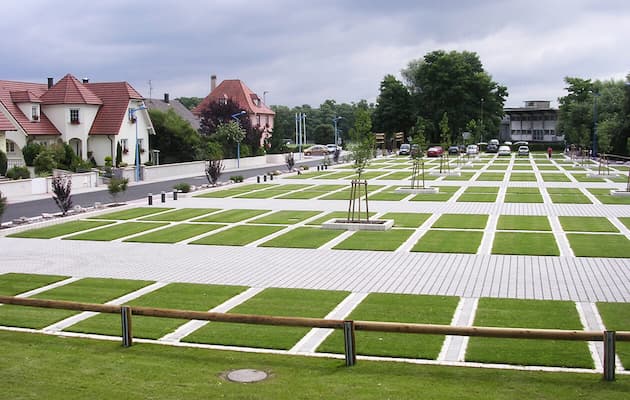
Reality is less poetic. A green parking lot costs about twice as much as a classic parking lot, but for what result? The grass finds itself in full sun, without shade and without regular watering. Cars parked on it deprive vegetation of any light. Predictable result: everything dies. Only burnt grass or a few stubborn weeds remain. The promised cooling effect? Nonexistent.
However, the disadvantages are very real. Instead of being smooth, the ground consists of honeycomb slabs that make circulation painful. Strollers roll poorly, it's impracticable on a scooter and dangerous for women in heels. How many sprains have been caused by an unfortunate landing on these irregular surfaces? You get out of your car in heels without paying attention to the ground and — surprise — a twisted ankle.
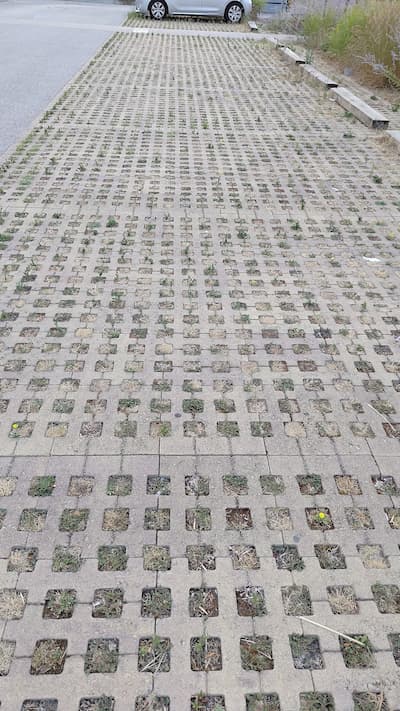
Another point: how do you clean these parking lots? For a classic parking lot, it's simple: the street sweeper can clean it quickly. But for a green parking lot, I have no idea. I suppose it must be complicated to eliminate oil leaks or debris stuck between the slabs. All this ends up embedded in the earth, little by little. Not sure it's very ecological... Amusing for a parking lot supposed to be "green."
Unlike debates about eco-neighborhoods where there are real advantages and real disadvantages, green parking combines all the defects without any benefit. And curiously, we never talk about it.
The Jane Jacobs Myth in the Amazon Era
Jane Jacobs remains an essential reference in modern urbanism. This American writer masterfully described the importance of public spaces and human relationships in urban life. Her books are fascinating and worth reading. But they were written in the 1970s, at a time when economic reality was radically different.
Jane Jacobs advocated for small neighborhoods with low buildings and, at ground level, a multitude of small shops. This was indeed wonderful in the 1970s. Since then, Amazon and big box stores have changed the game. We no longer have economically viable small local shops, and that's logical.
We buy on Amazon because it's cheaper, more convenient, and often faster. We shop at a hypermarket because it's simpler than going to the butcher, then to the vegetable merchant, then to the pharmacy. We no longer have physical banks — everything is digital. It's the same for insurance, telecommunications, and most services.
Nowadays, commercial ground floors are limited to a few convenience stores (overpriced), fast food, and a hairdresser. Not enough to animate the building bases of an entire neighborhood. If there's nothing left at the bottom of buildings, there's no reason to go out. Pedestrian neighborhoods end up empty of pedestrians. Only alcoholics remain in front of the corner convenience store. We're far from the dream promoted on social media.
Disguised Gentrification
In the United States, an urban trend is all the rage: destroying old small buildings to build beautiful attached townhouses. The result is indeed splendid — charming neighborhoods, walkable, with real architectural quality.
But putting townhouses in the best locations has never made housing more accessible. On the contrary: it mechanically reduces population density and explodes real estate prices. Replacing an old building with 4 apartments with townhouses divides by four the housing supply on a given plot. Mathematically, prices can only skyrocket.
these kinds of single family homes have been popping up all over chicago, nearly universally being constructed after landowners tear down an older building with 2-4 units of housing. this makes the population go down and rents skyrocket. they’re not a good model for urbanism https://t.co/oHE3msupkz
— emily north (@north0fnorth) August 9, 2025
This policy, presented as social and ecological, is in reality profoundly unequal. It reserves city centers for the upper classes while pushing the middle classes toward poorly served peripheries. The irony is that this "human" urbanism dehumanizes housing access for the greatest number.
The Worst of Both Worlds: Small Buildings vs Towers
The contemporary obsession with "human-scale buildings" produces an aberration: we get all the disadvantages of apartment living without any of its advantages.
What are the disadvantages of living in an apartment? Reduced spaces, no personal garage, no garden, noise pollution from neighbors, condo fees, promiscuity. What are the advantages? Proximity to downtown and lower maintenance cost than an individual house.
With four-story buildings, we keep all the disadvantages — cramped apartments, no parking, condo fees — but we lose the main advantage: proximity. Because with only small buildings, cities sprawl considerably. To go from one neighborhood to another, it's a hassle. We have almost all the disadvantages of the apartment building and almost no advantages.
Imagine the alternative: towers of 20, 30, or 50 stories. What changes? First, much more space per apartment. No more need to settle for 30 or 50 m²; you can easily make apartments of 80 to 200 m². With more apartments per building, charges are distributed over more condo owners — it costs less per housing unit.
Most importantly, more residents allow financing real collective facilities. A gym on the 3rd floor? You can get up 30 minutes earlier in the morning and do your session before work. Or in the evening when you get home. In a luxury building, you can have an indoor pool, sports courts, and a rooftop bar. Imagine: in the middle of winter, you come home from the office, change, take the elevator, and go swim in your building's pool!
If you're fortunate, you can even have the top apartment with panoramic city views.
High-rise buildings drastically reduce the necessary ground surface. So we can live much closer to each other and truly move on foot or by bike without systematically having 8 kilometers to travel. This reduces apartment disadvantages while amplifying their advantages.
The Dead End of Townhouses
Attached townhouses with small gardens, another urbanist obsession, symmetrically combine all the disadvantages of houses without any advantage. Constant maintenance: garden to dig, hedges to trim, 3 meters in front of the house to maintain, 2 meters on each side, 8 meters behind.
The garden is so small that you don't really enjoy it. But the neighbors have direct visibility onto it. No more private life. The gardens are so close that you hear all the neighbors' conversations — and vice versa. Even the garages are tiny and barely allow parking one car and storing a bike.
By wanting to create a compromise between buildings and individual houses, we get the disadvantages of both without the advantage of either. Neither the space and intimacy of real houses, nor the proximity and mutualization of real buildings.
Sometimes, you just have to make a choice rather than a mix between the two.
Current "intermediate" solutions — small buildings, townhouses — claim to offer the best of both worlds but often deliver the worst of both.
Conclusion: Choosing with Full Knowledge
The urban housing question perfectly illustrates this contemporary tendency to confuse political marketing with rigorous analysis. The idyllic images of eco-neighborhoods on social media are the equivalent of Instagram photos — they show the best angle at the best moment, but carefully silence daily life.
By wanting to look only at the positive of a development, we obscure all its defects. But each development has qualities and defects if you look closely. This skews all debates and makes it impossible to build a structured opinion.
Americans are dazzled by all the advantages of our urban developments but they don't see the disadvantages. I'm convinced they would prefer their conditions after living a few years in Europe.
A fact about American culture - many people want a single family house.
— Tesho Akindele (@Tesho13) May 12, 2024
Urbanists should work with that fact instead of fight against it.
We can create walkable neighborhoods and still have single family homes.
American urbanism doesn’t need to look like European urbanism. https://t.co/8ZIi4NvfFe
It's important to have a global vision to better understand the stakes of city planning and make informed decisions.
An honest housing policy should clearly present the trade-offs: if you want proximity, accept promiscuity. If you want space, accept car dependency. There is no such thing as a free lunch.
Are citizens so fragile that they must be spared these difficult choices? Don't they deserve to be presented with reality as it is, with its constraints and compromises, rather than being sold unattainable dreams?
These questions are disturbing, but they are necessary if we want to build cities that truly correspond to the needs of those who live in them — and not just the fantasies of those who plan them.