Cycling Every Day: Beyond the Myth
Published on November 6, 2025
Second article in a series on urban planning
The bike, the holy grail of modern urban planning.
I've been cycling for 10 years now. And when I say I cycle, I really do cycle, not like the so-called bike commuters. First, I did it as a cyclist with over 200 km minimum per week of training for 5 years. On the side, I had my other bike for daily life. And absolutely every day, I don't have a car or public transport pass.
It's a choice I make while measuring the consequences (mainly to avoid the costs of a car), but I recognize that it's far from being the perfect mode of transport as it's often sold in the media.
Bike Lanes
The recent development of cities to promote cycling has installed bike lanes everywhere. This was developed by bureaucrats or by weekend cyclist yuppies who have never had to travel dozens of kilometers daily. It's not practical at all.
The Sidewalk Bike Lane
This is spreading more and more, it's infernal. There's the problem of leaves and thorns as mentioned in my article on trees.
In addition to that, there are glass shards that can make us puncture, it's very common on sidewalks and it's almost never cleaned up. When it's on the road, cars by constantly driving scatter the glass shards, it's less annoying. With repeated passage, it goes away on its own, plus road maintenance regularly cleans the roads. On the sidewalk, this is not the case.
Added to that, we share the sidewalk with pedestrians: so we have to watch out for pedestrians, strollers, children, dogs and their leashes that can cut across our path.
There are also car exits from parking lots, houses, etc. They often don't have visibility because of the gate. So you have to ride slowly to avoid getting hit.
At each intersection, since we're on the sidewalk, we no longer have priority, whereas on the road, when it's a main road with stops on the sides, you go straight through without questioning. There, at each small street, you have to stop at the pedestrian crossing. It slows down ENORMOUSLY.
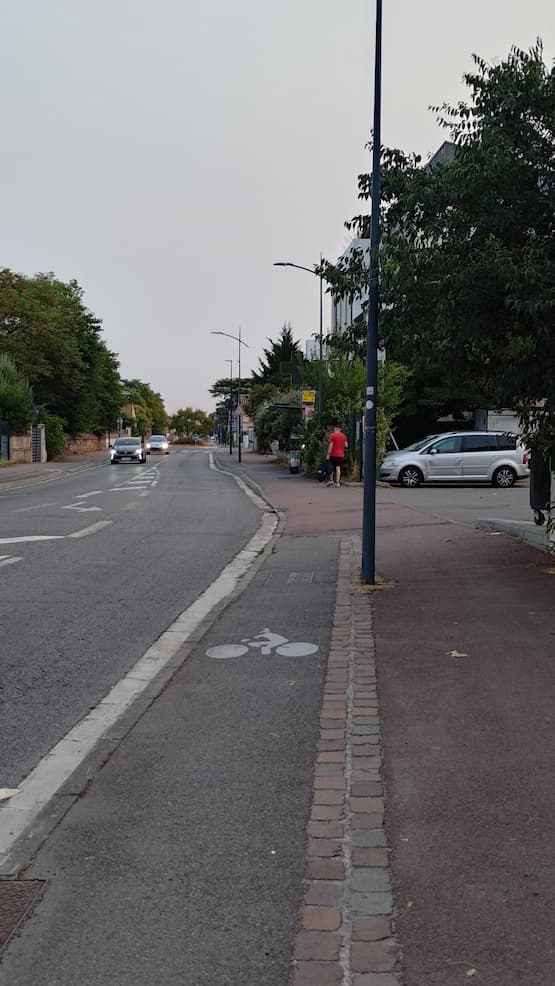
All these slowdowns are titanic. When you're a Sunday cyclist or an irregular bike commuter, it's not annoying, but when you have to cover distance every day, it's dramatic.
This is what makes the difference between a practical/profitable trip and an impossible trip. It easily wastes 30% of time on a trip, sidewalk bike lanes (and it pisses off pedestrians who are afraid of getting hit by a bike).
30% more time on a small 6 km trip is what can make the car trip profitable instead of the bike. And 6 km is nothing, we very quickly have 10-15 km trips. The time loss makes bike usage impractical. We're willing to lose 10 min/trip by bike if it saves us money compared to a car or transport trip. But if it takes 20 minutes more because of poorly designed bike lanes, it's no longer worth taking the bike.
The Separated Bike Lane
There are also the new "high-end" bike lanes that are separated from the road and sidewalk on a distinct zone embodying the ideal solution.
At first glance, it's the grail, but it has plenty of drawbacks. There's, as with what precedes, the problem of branches, roots (which make the bike jump because it's not clearly visible), thorns and glass shards. These lanes are never cleaned.
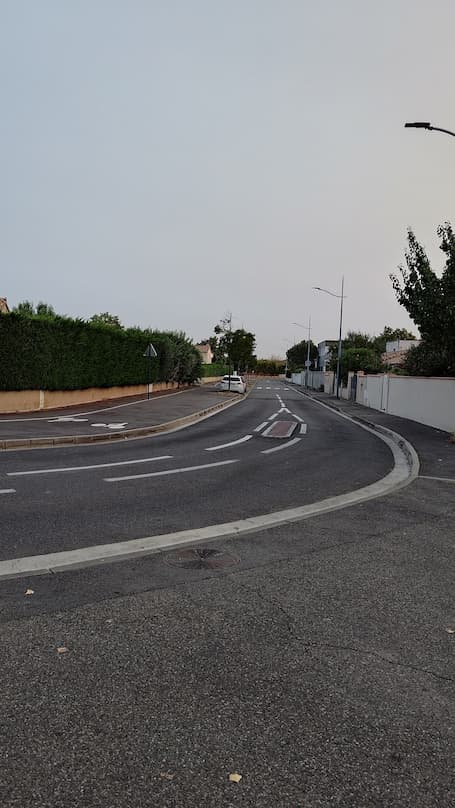
But there's also lighting: they're often not lit because they're not on the road. So the yuppies and bureaucrats, they don't care, they never cycle or occasionally during the day when it's nice. Except that for the real cyclist, he has to cycle every day.
And 6 months of the year, it's winter. How do you do on an unlit road in the morning when you go to work and when you come back? Because bike lights don't light well, they're not car headlights, we can't see the glass shards.
How do we do for 6 months a year? We still have to go to work and do shopping, right?
The Best Bike Lane
The best bike lane is the old one that was done everywhere before but that everyone hates. It drives me crazy because it shows that these people never cycle. It's the bike lane on the side of the road, the one that's 50 cm between the sidewalk and cars, separated by a white line.
It's the best because:
- we don't bother pedestrians
- there are no glass shards on the road
- if it's damaged (glass, leaves, etc.), regular car passage will remove impurities
- it's lit when it's dark because there's always lighting for cars, so we see very well
- we're on the road next to cars, so it's still very safe, we don't bother them
- we're on the road, so we always have priority at each intersection, we don't lose time
- if we want to turn left, just extend the arm, no need to leave the sidewalk or leave the specific bike lane
In short, these are the best bike lanes. It's no longer done because our politicians want to "do better," but it's what remains the most practical by far and the cheapest.
If we want to improve them, just reduce the gigantic sidewalk by 10 cm, it changes nothing for pedestrians and leaves more space for the cyclist on the road. Ten centimeters makes a big difference. Painting the lane green doesn't change anything at first glance, but it makes the marking more distinct between cars and cyclists, and I've noticed that cars tend to better respect the distance when it's painted green. It's silly but it works.
Weather
If we want to promote cycling, we must be able to do it every day, otherwise, if it's not possible certain days, it requires having another means of transport (often the only feasible one: the car). If 30 days a year, it's not possible, we're forced to buy a car (and therefore maintain it, insurance, have a parking space that penalizes everyone, etc.).
Except that the weather never cooperates.
In summer, it's too hot. Here in Toulouse, we must have 20 days a year that exceed 35 degrees and close to 2 months at over 30 degrees. Rare are the workplaces with on-site showers. How do we do? And even when there are some, everyone arrives at the same time and there's a queue in the morning at the work shower, it's impractical.
Doing 10 km by bike with this heat is certainly possible, but it's ultra unpleasant and frankly a bit dangerous sometimes.
There's often wind too in spring. When you have 12 km to go to work by bike and you get hit by headwind gusts all along at 8 am in the morning to go to work, it's chilling, and especially it slows down enormously.
Rain, same problem: it's doable but very unpleasant, and you need equipment that costs money and takes up space at home to store.
Snow is still very rare in France, but ice, that's easily a minimum of ten days a year, and depending on where you live, it can be much more. In a car, it's dangerous but you slide a little and that's it. But on a bike, it's fatal: the fall is immediate, it's no joke at all. How do we do then to go to work or do shopping?
When we take all these problems into account, we realize that the days when it's practical to cycle are rare.
Me, it annoys me, I see all the bike commuters in September when it's nice, not too hot, no wind, dry, long day so no need for light, cycling and saying how great it is as a mode of transport. But they're all absent in July during the heat wave, in winter when it's zero degrees on a bike, night and risk of ice, and in spring as soon as there's a bit too much wind.
The Separate Bike Lane on Twitter vs. In Real Life.
— BoumTAC (@BoumTACo) October 31, 2025
No lights, never cleaned, dog poop, glass on the ground, tree thorns, loose priority.
There are people who talk about bikes, and there are people who ride bikes.
But those are two different kinds of people.
Only one of these… https://t.co/0xEbfJOK6E pic.twitter.com/Jl1lFjMxXh
That's why we see cycling practiced in the Netherlands: it's never too hot there, winter is mild, there's certainly wind but it's the least painful of all bad weather. And it rarely rains hard there. Light rain is not annoying, it wets a little but with a coat it passes. The problem is heavy rain that soaks us in 5 minutes of cycling and ruins our visibility if we wear glasses (yet another problem with cycling).
Theft
A bike gets stolen too easily. We all know someone who had their bike stolen. It's so common that it's probably even happened to you.
It's problematic, bikes cost a lot now. If we want something solid to go to work without worry, something that holds up and will be used all the time, it's not cheap.
If every time we go out we lock our bike and we're afraid of having it stolen, it's a problem. If we can't leave a bike outside at night, it's problematic.
Storage
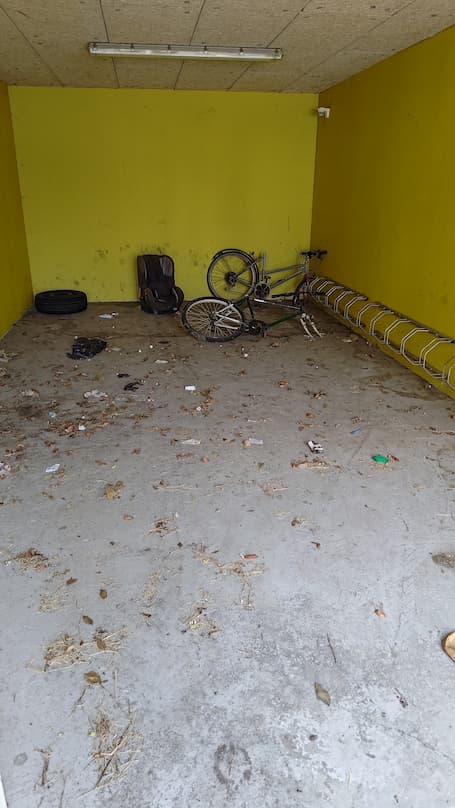
A bike takes up space, and of course in our great modern developments of our beautiful residences, there's no longer a personal cellar. So we can't store our bikes safely.
Some store them on terraces that serve as dumps. But it takes water and sun, the bike deteriorates quickly, it rusts.
Otherwise, there are common residence parking lots, but everything gets stolen in them.
Maintenance
With daily use, a bike deteriorates quickly, it's far from free maintenance either.
And as soon as we get caught in rain, it's devastating: it gets injected everywhere with gravel and you have to clean everything, otherwise everything deteriorates quickly (chain, derailleur, brakes, etc.). And it's another thing that takes time. In spring, it requires real maintenance.
When we hook it to a support, often there are other bikes and it takes shocks. The derailleur moves and it doesn't work well anymore, same for brakes and suddenly it gets stuck on the rim. The mudguard starts rubbing on the wheel. In short, small problems happen very quickly.
Practicality
As seen in all the previous points, it has plenty of drawbacks.
But how do you do shopping? Me, I manage, I live alone and I shop regularly so it fits in a bag, but how do you do when you live with two people? Or a family?
How do you go to an appointment far from home? To the doctor when you're sick? Or worse, injured (sprain, fracture, etc.)? It's already happened to me and cycling on one leg to go get an X-ray, I can tell you it's complicated.
How do you take your sick children? A luggage rack works to take children to school nearby, it's not far. But when they're sick and the doctor is 5 km away, how do we do? When you have to take them to the emergency room?
Animals to take them to the vet, how do we do when we only have a bike?
Distance
When you have to do 3-6 km, it works. 8 km, it's a bit of a stretch but it's okay too. But when it's 10 km? 12? 15 km? That's 30 km round trip, it's long. With a good bike to go to work, it works, but if it's to go to a friend's place one evening, it's not the same.
You'll tell me that 8 km by bike is fine. Of course it's fine, you're right, 8 km by bike is done without difficulty. But when it's every day, twice a day in all weather with a backpack to go to work or well dressed to go on a date, it's not the same. We have to distinguish between an 8 km ride for fun in nice weather in shorts and t-shirt and an everyday trip. Nobody wants to make an effort at 7:30 am to go to work to be on time for a client meeting.
There's a reason why as soon as you move slightly away from the city center there are almost no more cyclists.
If one winter evening or rainy evening a friend invites you to their place, even if there are only 4 km to do, it's demotivating. We don't want to move. It's painful and it requires effort. I know it, I'm 17 minutes from downtown by bike. I've missed a bunch of outings from laziness to do 20 minutes of cycling there and 20 minutes of cycling back.
Because cycling is tiring too. Certainly, it's not an intense effort, but nobody wants to do 30 min of physical activity before going to a restaurant one evening.
Do you see many people going to the cinema by bike? Then coming back at 11 pm to do 8 km on the return trip. No, nobody does that, it's painful. I do it and I know, I have NEVER seen anyone return from the shopping area by bike one evening.
When I go to the theater, there's never anyone by bike, I'm the only one.
When a friend invites you 6 km from home, you think twice about it, and you watch the weather non-stop, it's not pleasant to get caught in a downpour.
You've reserved a seat for a concert in a month 8 km from home. You hope it won't be too hot to go there so as not to arrive sweaty and that there won't be wind or rain. It's anxiety-inducing.
Conclusion
I see it, the bike, I've only had that as transportation for 10 years. I love it, but it's far from being the ideal mode of transport they sell us.
The ideal trip is 1-4 km. Below, might as well walk 10 min; above, it starts to be impactful: distance, sweating, painfulness.
It's just practical in the city to ride 2 km and join someone. Not too long, no time to get hot, not too tiring. It's not without reason that we see plenty of bikes in the city center but as soon as we leave the hyper center the quantity of cyclists decreases rapidly.
I love cycling and I love doing it, but I hate hearing so many people sell cycling as the ideal mobility solution when I never see them on the road as soon as conditions aren't ideal.
If you encourage promoting cycling so much, join me on the road.
I'm waiting for you with pleasure.