AI and the Industrial Revolution: Unexpected Parallels
Published on February 5, 2026
The industrial revolution of the 18th and 19th centuries transformed the world in an irreversible way. Before its arrival, the vast majority of the population, between 80 and 90%, was employed in agriculture to ensure everyone's subsistence. The days were long, the yields limited, and food often precarious. Then, with the invention of the steam engine, mechanical looms, and other innovations, everything changed. Today, in developed countries, less than 2% of the working population is employed in agriculture. Yet, we feed more than 8 billion human beings, with a quality and variety of products far superior to what was once imaginable.
This transformation did not only reduce the number of farmers; it both complicated and simplified professions at the same time. Repetitive manual tasks were automated, freeing up time for innovations like chemical fertilizers, automatic seed drills, or high-tech harvesters. The farmer's profession has become more technical, involving knowledge in biology, mechanics, and data management. But it is also more productive: a single person can cultivate vast lands and optimize resources to minimize waste. Less manpower, but an agriculture that is essential and more efficient than ever.
I see a striking similarity with the artificial intelligence (AI) emerging today. Like the industrial revolution, AI multiplies our human capabilities. It allows us to perform tasks that were once impossible or prohibitively expensive. Think of translating ancient languages, real-time analysis of medical data, or creating complex software. But, just as machines replaced arms in the fields, AI risks drastically reducing the need for manpower in many sectors. We will produce more, better, and faster, but with fewer people to keep up the pace. This evolution raises profound questions about employment, society, and the future of work.
Ordinarily, most innovations only produce incremental gains. An electric tool replaces a manual one and makes you go 15% faster: the power drill versus the screwdriver, the chainsaw versus the hand saw, the dishwasher versus hand washing, word processing versus the typewriter, modern Excel versus paper accounting, GPS versus the road map. Each time, we gain a few percentage points of efficiency, save a little time, reduce fatigue. No one panics: we reallocate this saved time to more tasks, more customers, more comfort. Even classical industrial automation (robotic arms, lean production lines) often improves yields by 10 to 30%, sometimes 50% in the best implementations, but rarely does it multiply per capita production by 5 overnight.
AI operates a different qualitative and quantitative leap: it doesn't make you go "a little faster"; it gives you a multiplicative lever. A developer assisted by AI can write, test, document, and deploy in one day what used to take a week. A single translator becomes a team. A marketer instantly gets creative variants that would have taken several cycles to produce. We go from +15% to x3, x5, sometimes x10 in cognitive pace. It's no longer marginal optimization; it's a radical compression of intellectual production cycles. And it is precisely this rupture (shifting from the percentage regime to the multiplier regime) that makes the potential social impact more brutal: far fewer people needed to accomplish all the tasks of an entire service.
Lessons from History: Productivity versus Jobs
Let's go back to the industrial revolution to better understand. At the beginning, it caused major social upheavals. The enclosures in England drove peasants from common lands, pushing them toward urban factories where conditions were often miserable. Movements like Luddism saw workers destroy machines out of fear of job loss. Yet, in the long term, industrialization created new professions: engineers, managers, skilled workers. Productivity exploded, enabling economic growth that lifted millions out of poverty.
However, a key aspect is often underestimated: the net reduction in the manpower needed per unit produced. In agriculture, for example, tractors and combine harvesters allowed a farmer to cultivate ten times more land than before. Today, drones monitor crops, IoT sensors optimize irrigation, and algorithms predict plant diseases. The result: abundant food for an overpopulated planet, with a lower ecological footprint. But how many farmers remain? Far fewer than before, and the profession, though vital, no longer absorbs the majority of the active population.
AI follows a similar trajectory, but at an accelerated speed. Unlike physical machines that automate manual tasks, AI targets cognitive processes: analysis, creation, decision-making. It is not yet perfect, but its progress is exponential. Models like GPT-5 or Sonnet 4.5 already handle complex tasks with superhuman efficiency. In the coming years, it could transform entire industries, rendering obsolete roles that we considered "safe".
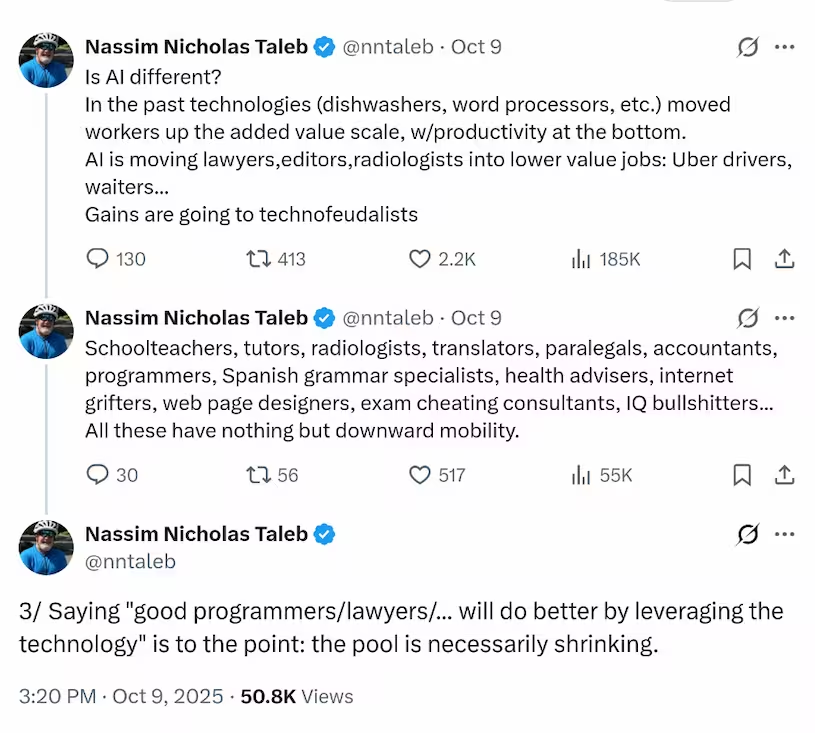
Taleb points out a historical inversion: past technologies, like dishwashers or word processors, freed workers from basic tasks to elevate them to higher value-added roles. AI, on the contrary, threatens high-level intellectual professions. Radiologists who analyze scans might end up supervising basic algorithms, while junior programmers become redundant in the face of automated code generation tools. Productivity gains primarily benefit a technological elite, leaving others with downward mobility.
The Impact of AI on Creative and Technical Professions
Let's take a concrete example in the field of software development, a sector often seen as resistant to automation. Imagine a company like Decathlon, a leader in sports e-commerce. Before AI, maintaining such a complex website—with stock management, personalized recommendations, logistics optimization—required a team of developers, data scientists, and DevOps engineers. Adding a new feature, like a module for an international market, could take months and cost a lot in working hours.
With AI, everything changes. For Decathlon, this means developing recommendation algorithms more simply, without recruiting an army of experts. AI can optimize shipments by predicting the most efficient routes, generate multilingual product sheets from basic descriptions, or even automatically validate customer comments to detect fraud. Marketing also benefits: targeted campaigns are created in a few hours, instead of weeks.
The result? Decathlon can innovate faster and at lower cost. Entering a new market, like Asia, becomes accessible without doubling the technical team. But there is a limit: the company remains a sports e-commerce specialist. AI optimizes existing processes—stocks, UI/UX, SEO—but does not reinvent the core business. Like a farmer using GPS to plow more precisely, the developer at Decathlon produces more value, but the ceiling is there. Once marginal gains are exhausted, AI accelerates optimization, but the need for personnel decreases. A team of 50 might suffice where 200 were needed before.
Another striking example is translation. Traditionally, translating an entire book required months of work by a human expert. But AI has revolutionized this, as illustrated by this tweet from a user:
I paid one of the top literary translators of my mother tongue to have my book translated from for my mom, coz I’m bad at translating. It took him 3 months to do half the book, I did the other half in a week with AI and the result was superior.
— Arayan Apatrid (@AApatride) October 9, 2025
I felt sorry for the human and did…
Here, the author describes how he translated half a book in one week with AI, surpassing the work of a seasoned professional who took three months for the other half. For businesses, this means translating legal or marketing documents in real time, at a fraction of the cost. But for translators? Many risk having to retrain, as AI excels in routine tasks and even creative ones, as we see now with Sora for video.
Let's also think about medicine. Radiologists, who spend hours scrutinizing MRIs to detect tumors, see AI as a direct competitor. Algorithms trained on millions of images diagnose with equal or superior precision to humans, and in seconds. A hospital could halve its radiology team while treating more patients. Similarly, in law, paralegals who search for legal precedents are replaced by chatbots that scan entire databases instantly. Junior lawyers, once trained on these tasks, might find themselves without an entry-level role.
Downward Mobility for Qualified Professions
As Taleb points out, what makes AI unique compared to past innovations is that it does not eliminate subordinate jobs to enable social ascent, but on the contrary, it targets qualified professions, leading to downward mobility. In the past, technological advances eliminated ungrateful and manual tasks—factory workers replaced by robots, cashiers by self-checkouts—freeing workers to climb the social ladder to more valued roles. AI reverses this logic: it directly threatens high intellectual professions.
This "downward mobility" also affects education. Tutors and teachers could be supplanted by personalized AI platforms. Have you ever tried learning a subject you don't know by asking questions to ChatGPT? It's exceptional. An accountant checking balance sheets? Software does it automatically. A therapist at 50€ per hour? Grok has a therapist mode. Need a Spanish teacher? Chat in voice mode with any AI; it will help you practice the language and correct you as needed. It's free.
AI as an Extension of Our Capabilities
Despite these challenges, AI represents a tremendous advance, similar to what agriculture achieved through mechanization: immense productivity that allows feeding the entire world with far less manpower. But as in modern agriculture, where less than 2% of the population suffices to produce for all, there will no longer be room for everyone in the AI-boosted economy. The gains will be enormous—more efficiency, more innovation. But they will involve a drastic reduction in job needs in many sectors.
It is crucial to stay vigilant and adapt quickly to this unprecedented transformation. Unlike previous technological revolutions, this one directly disrupts qualified professions, which are usually spared such changes. These professions, which enjoyed stability acquired after years of study and experience, are now threatened. It will be quite a shock when people discover, after 5 years of study and 15 years of experience, that their profession no longer exists—forcing them into massive and unexpected retraining.
Yet, I remain optimistic. AI offers a unique opportunity to learn even more than before, to discover new fields, and to push the limits of our skills. It is an extension of ourselves, like a tractor amplifies the farmer's strength: it propels us toward achievements that seemed impossible yesterday.